
As we step into 2026, the marketing landscape is undergoing one of the most significant strategic shifts in decades. In this article, Dr Leeya Hendricks, Fellow of the Chartered Institute of Marketing, Chartered Marketer and author of ‘The platform playbook’ explains how marketers can lead and accelerate this change.
For years, the marketing funnel shaped how organisations understood customer journeys, designed campaigns and measured success. It offered a neat, structured way to move buyers from awareness through to conversion. But the world marketers now operate in looks nothing like the one the funnel was designed for.
Customers navigate across platforms, communities, creators, partners, apps and touchpoints in non-linear, unpredictable ways. They co-create value, not simply consume it.
They engage with ecosystems, not isolated brands. And platform models-from B2B SaaS to fintech, professional services, marketplaces and subscription-led models - have redefined how organisations scale.
Why the funnel is no longer the dominant mental model
The traditional funnel assumes the organisation controls the journey.
Modern ecosystems prove the opposite: control has shifted to the customer.
1. Customer journeys are fluid not linear
Customers jump between channels, devices and platforms based on context, need and signal. Their decisions are shaped by networks, reviews, communities, partners and content far beyond brand-owned touchpoints.
2. Value is created through actor networks
Where organisations once operated alone, they now operate as ecosystems-platforms, complementors, collaborators, technology providers, distributors, creators, integrators and domain specialists.
3. Platform dynamics shape expectations
Whether B2C or B2B, customers increasingly benchmark experiences against integrated, personalised and frictionless platform environments.
From funnels to ecosystems: the pivotal shift
One of the core ideas explored in The Platform Playbook is that marketing must evolve from managing a path to orchestrating a system.
Orchestrating actor engagement
Ecosystems thrive when actors-customers, partners, complementors, regulators and communities play distinct and reciprocal roles. Marketing becomes the orchestrator of those interactions, not merely the storyteller.
Leading value co-creation
Instead of pushing value to customers, platforms pull value from and with them. Marketers must design co-creation loops, feedback mechanisms, interactive content, community experiences and partner-enabled value.
Designing interfaces and interactions
In platforms, “place” becomes “interface” with marketing influencing the design of essential levers of platform growth including:
- digital touchpoints
- partner integrations
- API-led interactions
- knowledge hubs
- community spaces
Scaling participation
Platform success depends on participation: onboarding, activation, contribution, and advocacy. Marketing becomes the architect of these participation journeys-alongside product, technology and commercial leaders.
What this means for marketers - the new leadership role
This shift elevates the marketer into a more strategic, design-led, systems-aware role. In platform ecosystems, marketers become:
Customer-value architects
Not just messaging experts, but designers of the end-to-end value experience across multiple actors.
Ecosystem storytellers
Great ecosystems are held together by shared purpose, shared value and shared narrative. Marketing crafts and communicates this narrative across markets, partners and communities.
Co-creation facilitators
From customer advisory boards to partner showcases, from collaborative content to open innovation - marketers design the mechanisms that invite contribution.
Data and signal interpreters
Ecosystems produce complex, interdependent data flows. Marketers must extract insight that informs, an ability which is central in the “Co-Creation Engine” model introduced in The Platform Playbook:
- where value exchanges are strong
- where friction exists
- which actors are becoming core or peripheral
- how the ecosystem is evolving
Growth orchestrators
Platform-driven growth is not linear. It grows through network effects, complementor expansion, integration layers and actor engagement with marketing playing a leading role in activating those dynamics.
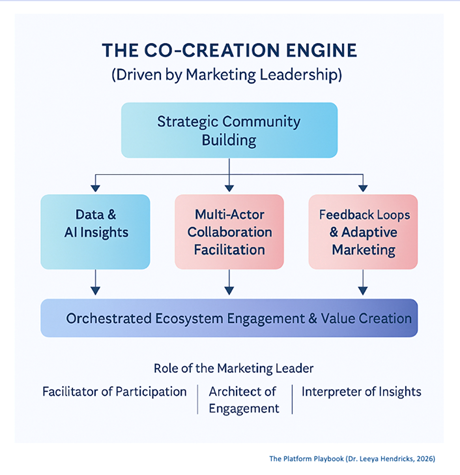
How marketers can lead platform-driven growth
Leading in an ecosystem environment starts with widening the lens beyond the customer journey to map the full network of actors and the value that flows between them. Activation becomes more important than acquisition, because early participation fuels engagement, contribution and scale.
Partner-enabled value is essential, as integrations, shared data and co-created propositions strengthen the entire ecosystem. This requires adopting a true Platform Rebel mindset - challenging silos, collaborating deeply with product and technology teams, and experimenting with new interfaces and community-led approaches.
Ecosystems thrive on continual contribution. Advisory groups, partner forums, user councils and co-created content loops build momentum and keep value circulating across the network.
The future belongs to marketers who can think in systems, not stages. The shift from funnels to ecosystems is a significant change in marketing. The marketers most likely to lead platform growth will:
- design for participation
- orchestrate across actors
- drive co-creation
- collaborate deeply with technology
- understand networked value
And these principles form the foundation of The Platform Playbook - a practical, strategic and action-oriented guide for marketers navigating a world where linear journeys have been replaced by interconnected ecosystems.
The funnel shaped the past. Ecosystems will shape the future. And in 2026, marketers have a defining opportunity to lead, orchestrate and accelerate this shift.
If you’re looking to advance your marketing career, the CIM Marketing Leadership programme has been developed to respond to both industry and individual needs within the marketing profession. The programme will develop you as a marketing professional into an advocate for leading change within the dynamic organisation.

Related content
Explore related content and courses for further insight


